








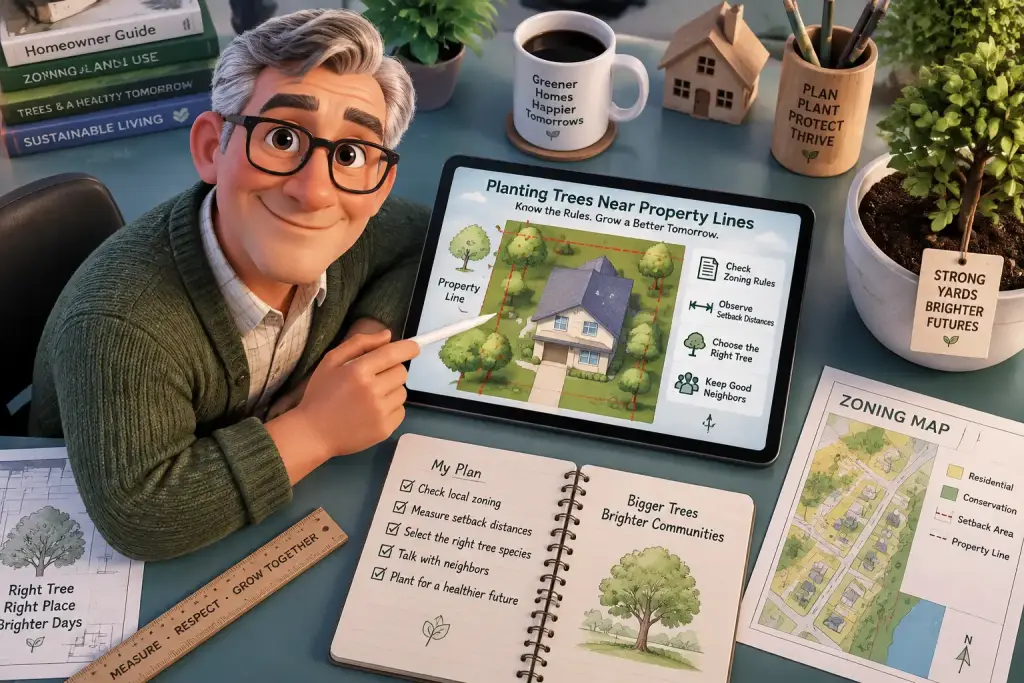
Start with a tape measure. Property line trees can add shade, privacy, and bird cover, but a poor planting spot can also create root damage, branch fights, drainage concerns, and local zoning trouble years later. A careful check now usually takes less than an hour and may save thousands of dollars in removal or repair work.
- Confirm the real property line with a survey, plat map, or local land records before choosing a planting spot.
- Check local zoning, tree protection, drainage, and utility rules before planting large trees near a boundary.
- Pick a tree size that gives roots and branches room on your own side for its full mature life.
Table of Contents
Mark the line before choosing a tree
Mark the real property line before you buy or plant any tree. A fence, hedge, old stake, or mowing edge may sit inside one owner’s yard, so use a survey, plat map, or clear land record instead of guessing.
Start with the papers from your home purchase. Look for a survey drawing, parcel map, or plat map that shows boundary points, lot size, easements, and rights of way. A survey may show metal pins at lot corners, but do not dig widely to find them. Digging near a buried utility line can be unsafe, and moving a survey pin can create a serious problem.
Walk the boundary with a measuring tape, phone camera, and notebook. Take photos of fences, existing trees, utility boxes, drainage ditches, and visible boundary markers. Write down the distance from your planned planting spot to the line, house, fence, driveway, and overhead wire.
A five-minute boundary check
In everyday use, this step takes about five minutes once you have your map open. Mark the proposed spot with a small flag or a stone, then stand back and picture the tree at full size, not at nursery size.
- Open your survey or local parcel map.
- Find the two nearest boundary points.
- Measure from the planned tree spot to the boundary.
- Check for fences, drains, utility boxes, and wires.
- Write the measurement and date in your home file.
If the line is unclear, a licensed land surveyor is the safest person to confirm it. A tree seller, neighbor, fence builder, or real estate listing cannot make a legal boundary decision. This may feel slow, yet it is far easier than dealing with a mature oak or maple planted on the wrong side.
How close can trees grow to a property line?
Tree spacing near a property line depends on local rules, the tree’s mature size, and any special site limits. There is no single national setback rule, but planting farther from the boundary gives you better control of roots, branches, and future care.
Small ornamental trees, such as serviceberry or dogwood, may fit closer to a line when local rules allow it. Even then, check their mature canopy width and root spread. A tree that is only 5 feet tall in a pot may grow 15 to 25 feet wide after several years.
For a simple starting rule, plant a tree at least half of its expected mature canopy width from the boundary. A tree expected to spread 20 feet wide should start about 10 feet from the property line. This is not a legal rule, but it helps keep most large limbs on your side.
Large shade trees need more room. A mature oak, sycamore, cottonwood, poplar, or silver maple can spread 40 to 70 feet or more, depending on type and care. Putting one 6 feet from a line may look fine for ten years, then become hard to manage when limbs reach a roof, fence, or neighbor’s garden.
Use mature size, not pot size
Read the nursery label, then check a trusted local tree guide for mature height and canopy width. Look at the botanical name too, because common names can cover several types with very different growth habits. A compact maple and a fast-growing silver maple may both be sold as “maple,” yet they need very different space.
Roots do not stop at a straight line underground. They often spread well beyond the outer branches, especially in loose or watered soil. Roots may lift shallow paving, press against old fence posts, and enter cracked drain lines, although healthy pipes normally do not attract roots by themselves.
Check zoning rules for property line trees
Check local zoning and environmental rules before planting property line trees, especially on protected land or near water. Your city, county, homeowners association, or conservation office may set limits for tree removal, drainage work, fire safety, sight lines, and protected species.
Start on your local planning or zoning website. Search using plain terms such as “tree planting,” “tree protection,” “setback,” “right of way,” “stream buffer,” or “native vegetation.” If the rule text is hard to read, call the planning desk and ask a simple question: “Can I plant a tree this far from my side boundary, and are there any special limits?”
Environmental zoning often matters most near wetlands, streams, lakes, steep slopes, flood areas, or protected woodland. A buffer area may limit digging, soil movement, fertilizer use, or removal of existing plants. The rule may apply even when the area looks dry for part of the year.
Drainage is another concern. A new tree usually helps soil hold water over time, but the planting work can still disturb a swale, rain garden, ditch, or shared drainage path. Do not fill a low area with extra soil just to make planting easier. That change may send water toward a neighbor’s yard.
Rules worth checking first
- Tree protection rules for large or native trees already on the lot.
- Wetland, stream, lake, or drainage buffer limits.
- Corner lot sight-line rules near streets and driveways.
- Utility easements and public right of way areas.
- Fire safety rules in dry or wooded areas.
- Homeowners association planting rules, if your community has them.
Utility easements deserve special care. Your land may be inside your property line, but a utility company may still need access for power, water, sewer, gas, or cable work. A large tree in that area can later be cut back or removed. Before digging, contact your local utility marking service and wait for marks on the ground.
Property projects often connect. If you are also changing a fence or patio near the same edge, review our guide to fence and patio rules before you set final locations. Planning these items together can prevent a tree from blocking a future gate, drain, or repair path.
Use roots, branches, and water to set spacing
Set tree spacing by looking at roots, branches, water flow, and nearby structures as one group. A tree can meet a basic boundary setback but still cause trouble if it crowds a drain, shades a solar panel, blocks a driveway view, or grows under power lines.
Measure from the center of the trunk location, not from the edge of the nursery pot. Then add the tree’s mature canopy radius, which is half its expected mature width. This gives you a clear picture of where branches may reach after 10, 20, or 30 years.
| Site check | Simple spacing guide | Why it matters |
|---|---|---|
| Property line | Use half the mature canopy width | Helps keep major limbs on your side |
| House foundation | Keep large trees 15 to 25 feet away | Leaves room for roots, gutters, and repairs |
| Driveway or path | Keep trunks 8 to 12 feet away | Reduces root lift and blocked access |
| Overhead wires | Choose trees under 25 feet mature height | Reduces pruning and power safety risks |
| Drainage swale | Plant outside the active flow path | Keeps water moving as designed |
Use the table as a planning guide, not a replacement for local rules. Soil type can change the result. Clay soil may hold water and lead roots toward the surface, while sandy soil can dry quickly and push a young tree to seek water farther away.
When we tested this setup in a small side yard, marking the future canopy with a garden hose made the choice much clearer. The young tree looked tiny at first, but the hose circle showed that its mature branches would cover half the shared fence. We selected a smaller native tree instead and kept a clear walking strip beside the fence.
Do not plant directly below large overhead wires unless the selected species is known to stay low. Utility pruning can leave a tree with poor shape and weak branch cuts. Check the planned spot from several views, including from the street, your driveway, and your neighbor’s most used outdoor area.
Use the tree's mature canopy width as your first spacing guide. Planting at least half that width from the property line often keeps major branches on your side longer.
What should you ask a neighbor before planting?
Tell your neighbor about a planned boundary tree before planting, even when the tree will be fully on your land. A short, calm talk can prevent surprise and gives both homes a chance to spot issues like shared fences, garden beds, views, pets, or drainage.
You do not need permission for every legal planting on your own property, but early contact is still a good habit. Show the tree type, the planned trunk location, and its expected mature size. Explain that you checked the property line and want enough room for normal pruning from your side.
Keep the talk practical. Ask if there is a buried drain, irrigation pipe, old fence footing, or garden feature near the boundary. Your neighbor may know about a wet spot after heavy rain, a hidden cable route, or an old tree stump that does not show on a map.
A simple neighbor script
Try this: “I am planning to plant a small tree about 10 feet inside my boundary. It should grow about 20 feet wide. I wanted to show you the spot before I plant, and check if you know of any drains or other issues near this fence.”
Put key details in writing after the talk, even if the conversation is friendly. A short text or email can note the date, tree type, trunk location, and any shared plan for access. This is not about mistrust. It gives both households the same clear memory later.
Shared boundary trees need extra care. A trunk that sits exactly on a property line may be owned by both neighbors under some local rules. Do not cut, remove, poison, or heavily prune a shared tree without checking local law and speaking with the other owner. Damage to a shared tree can lead to expensive disputes.
Keep branches trimmed on your side where safe and lawful. If a branch crosses the line, rules vary by place, especially if trimming could harm the tree. A qualified arborist can explain safe cuts and provide a written report if the tree appears weak, diseased, or dangerous.
Plant with a plan for the first three years
Plant at the right depth and care for the tree through its first three years. Good early care helps the tree grow steady roots, handle dry periods, and stay less likely to lean, fail, or push toward nearby fences and structures.
Dig a hole two to three times wider than the root ball, but no deeper than the root ball itself. The root flare, where the trunk widens into roots, should sit at or slightly above the final soil level. A tree planted too deep may grow slowly and suffer from poor root health.
Remove plastic pots, wire baskets, tags, and tight ties. Loosen circling roots with clean hand tools if they are thick and wrapped around the root ball. Backfill with the soil you removed unless local soil advice tells you otherwise. Rich soil placed only in the hole can keep roots from spreading outward.
First-year watering routine
Water deeply and slowly, rather than giving short daily sprays. For a new small tree, 5 to 10 gallons once or twice a week may work during dry weather, but adjust for rain, soil, heat, and local water limits. The goal is moist soil, not a puddle around the trunk.
Place a 2 to 3 inch layer of wood chip mulch in a broad ring around the tree. Keep mulch a few inches away from the trunk. Mulch piled against bark can hold moisture, invite pests, and cause rot. Make the mulch ring wider each year as the tree grows.
Check the tree once a week during its first growing season. Look for dry soil, chewed bark, loose stakes, rubbing ties, broken branches, or leaves that suddenly wilt. Remove stakes after the tree can stand on its own, often after one growing season. A trunk needs some natural movement to grow strong.
Record what you do in a notebook or phone note. Write the planting date, tree type, source, watering days, mulch depth, and any signs of stress. That record helps if you need advice from a local arborist or need to show that the tree was cared for properly.
If a shed, charger, or other yard project may come later, leave room now. Our guide to backyard shed zoning can help you avoid placing a new tree where future building space may be needed.
Keep a record as the tree matures
Keep simple records and inspect boundary trees every season as they mature. Photos, measurements, and regular pruning notes help you spot growth problems early and show a clear history if a neighbor, insurer, or local office asks questions later.
Take photos from the same two or three points each spring and fall. Include the trunk, the property line area, lower branches, and nearby fence or roof. Measure trunk width once a year at about 4.5 feet above ground if the tree is large enough. A steady record makes slow changes easier to notice.
Watch for branches that rub a roof, block a driveway view, touch utility wires, or hang over a shared path. Small corrective cuts are easier and safer than removing a large limb later. Do not top a tree by cutting off major upper branches. Topping can cause weak new shoots and poor tree health.
Call a qualified arborist when you see deep trunk cracks, mushrooms at the base, sudden leaning, dead upper limbs, cavities, or soil lifting near roots. These signs do not always mean the tree will fail, but they need a trained inspection. Keep the written report with your property records.
Review local rules again before major pruning or removal. Tree rules can change, and a tree may gain protected status once it reaches a certain trunk size. Your local office may also require a permit for work near wetlands, public streets, or utility areas.
A well-placed tree becomes easier to care for each year. The best result is simple: enough room for the tree, a clear boundary for both homes, healthy soil, safe drainage, and fewer hard talks later. Planting with that long view turns a small yard project into a lasting part of a good home plan.

Letizia Neri
Founder & Environmental Zoning EditorLetizia Neri, born and based in Roma, Italy, is the founder and lead editor of Eco Zoned. She helps homeowners understand local environmental zoning rules through practical, plain-language advice for planning projects and making informed property decisions.